

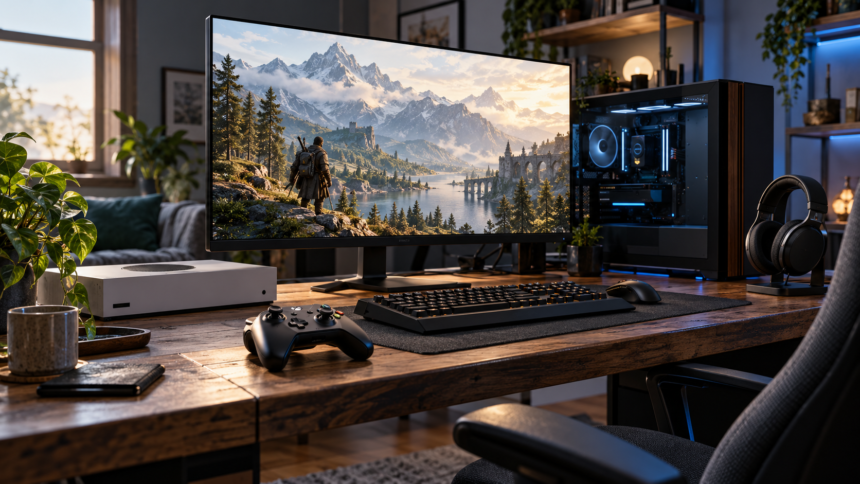
Searching for “eurogamersonline the different types” brings up several interpretations: the sections of a gaming website, the kinds of games people play, and the motivations behind playing them. The clearest answer starts with EuroGamersOnline’s own navigation, which lists Console Gaming, PC Gaming, and Gadgets. Those are editorial categories. To understand gaming more fully, it helps to separate them from genres, multiplayer modes, and player preferences.
What Does EuroGamersOnline Cover?
The EuroGamersOnline homepage provides a straightforward starting point through three navigation categories:
- Console Gaming: coverage organized around playing on consoles.
- PC Gaming: articles grouped around computer gaming.
- Gadgets: coverage labeled around devices and accessories.
These labels help readers navigate the site, but they do not form a classification of every game or gamer. A console game can be a strategy title, a role-playing adventure, or a competitive shooter. A headset is equipment, rather than a separate style of play.
The distinction matters when searching for useful information. Someone troubleshooting a computer game needs platform-specific advice. Someone deciding whether a game sounds enjoyable needs details about its mechanics and modes.
Gaming “Types” Answer Different Questions
Much of the confusion disappears when you identify what a label actually describes.
| Category | Question it answers | Examples |
|---|---|---|
| Platform | Where do you play? | PC, console, smartphone |
| Genre | What activities shape the game? | Role-playing, strategy, racing, puzzle |
| Mode | How do you play with others? | Single-player, cooperative, competitive |
| Motivation | What makes you want to keep playing? | Discovery, progress, friendship, mastery |
| Equipment | What do you use to play? | Controller, keyboard, headset |
Consider a hypothetical cooperative role-playing game on PC. “PC” identifies the platform, “role-playing” describes the genre, and “cooperative” explains the relationship between players. One person might enjoy developing a character, while another joins mainly to spend time with friends.
Each description adds information. None replaces the others.
Game Genres: Look at What You Actually Do
Genres are useful shortcuts, especially when a review explains the activities behind the label.
Action games emphasize activities such as movement, timing, combat, or rapid responses. Shooters and platformers describe more specific kinds of action.
Role-playing games, usually shortened to RPGs, commonly involve developing characters through abilities, equipment, or other progression systems. The balance of story, exploration, and combat varies by game.
Strategy games emphasize decisions about resources, positioning, or longer-term plans. Check whether play proceeds in turns or in real time; that difference can matter more to your enjoyment than the broad genre.
Simulation and management games center on operating or managing systems. Read beyond the label to find out whether the experience favors detailed realism, creative freedom, or accessible rules.
Puzzle games build challenges around solving problems, recognizing patterns, or applying rules. A puzzle game may still include time pressure, so the label alone does not guarantee a relaxed experience.
Games can combine these elements. Valve’s Steam Tags documentation distinguishes genres and subgenres from other descriptors, including visual properties, themes, features, and player support. That makes a useful reading habit: look for several relevant characteristics instead of expecting one label to explain everything.
The Four Bartle Player Types—and Their Limits
If “different types” means types of gamers, Richard Bartle’s 1996 paper, Hearts, Clubs, Diamonds, Spades: Players Who Suit MUDs, offers a specific historical framework. It describes four approaches to playing MUDs, or multi-user dungeons:
- Achievers pursue game-defined goals, points, and advancement.
- Explorers investigate the world and experiment with how it works.
- Socializers prioritize relationships and interaction with other players.
- Killers, in Bartle’s terminology, seek to impose themselves on other players, often through attacks or interference.
That last category should not be casually equated with everyone who enjoys competitive games. Bartle’s description concerns acting on other players and demonstrating superiority within the virtual world.
The paper also recognizes overlap: players can move between approaches depending on their mood or playing style. Its original setting matters, too. This is a framework developed around MUD play, rather than proof that every modern player belongs to one of four permanent personality groups.
Use it to reflect on what you enjoy, while leaving room for preferences the framework does not fully capture.
How to Find the Experience That Fits You
Start with the experience you want from a session. Do you want to solve something alone, explore at your own pace, cooperate with friends, or test your skills against opponents?
Then check the details that can make that experience possible:
- For social play: confirm the supported player count, cooperative mode, and compatibility with your friends’ platforms.
- For shorter sessions: investigate match length, save options, and whether you can pause.
- For exploration: look for information about freedom of movement, discovery, and how strongly the game directs your progress.
- For competition: examine the actual competitive modes rather than assuming that “multiplayer” means ranked play.
For US readers choosing games for children, the ESRB Ratings Guide adds another useful layer. Its rating categories address age suitability, content descriptors explain relevant material, and interactive elements flag features such as user interaction and in-game purchases. Those interactive notices do not determine the assigned age rating.
The practical answer to this search is therefore a set of separate questions: what does the website cover, where does the game run, what does playing involve, and why might you enjoy it? Keeping those questions distinct makes gaming descriptions easier to understand—and much more useful.
Read also How to Keep December Birthdays Separate from Christmas
Sources
- EuroGamersOnline — Home
- Steam Tags — Steamworks Documentation
- Richard Bartle — Hearts, Clubs, Diamonds, Spades: Players Who Suit MUDs
- ESRB — Ratings Guide
Read also Where to Find Gaming Tournaments: TheHakEvent and US Options