

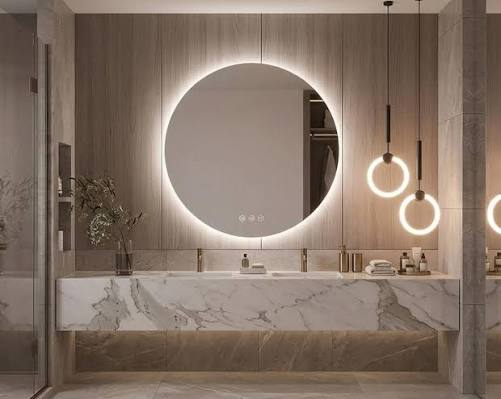
A bathroom can look bright while leaving your face in shadow at the mirror. Ceiling lighting and mirror lighting perform different jobs. Plan them together so the room is comfortable to move around and practical for shaving, skincare or applying make-up.
Start with the final positions of the basin, bath and shower. These affect both the visual layout and the electrical requirements. A bathroom is a wet environment, so have a registered electrician assess product suitability and installation before you buy.
Draw the mirror and the person using it
Mark the mirror size and typical standing position on the bathroom plan. Consider whether different members of the household will view it at different heights. A shallow cabinet, projecting shelf or mirror frame can change the shadows you see.
A light directly above the head may illuminate the basin but produce shadows around the eyes. Consider suitable mirror lighting that brings light towards the face, rather than expecting the main ceiling layout to do every job.
If the mirror has integrated lighting, check what that lighting is intended to provide. A decorative illuminated border may give a different result from a fitting designed to illuminate the face. Assess the actual product where possible.
Choose LED Downlights for the room around the mirror
Bathroom-suitable LED Downlights are available through LightHub Direct, alongside different styles and protection ratings. Selection still needs to match the particular location and installation conditions.
LED downlights can provide general illumination for the shower approach, storage and circulation area. Their positions should complement the mirror lighting. Avoid clustering every fitting around the basin while leaving the rest of the room poorly served.
Check the output and beam distribution of the proposed model. A small room with pale surfaces behaves differently from a large bathroom with dark tiles. The number of LED downlights should follow the design, rather than a fixed number applied to every bathroom.
Assess glare from the bath as well as the doorway
The view from a bath is often overlooked during lighting planning. A ceiling fitting that appears unobtrusive when standing can be directly in your line of sight when reclining.
Mark that sightline before confirming positions. Depending on the room, a different position or an appropriately designed recessed light source may be more comfortable. A product described as anti-glare still needs to be assessed in the proposed layout.
Glossy tiles and mirrors can reflect LED downlights into unexpected places. Check the reflected view as well as the direct one. Moving a fitting slightly at the planning stage may prevent an irritating reflection after the ceiling is finished.
Compare white light without confusing it with brightness
Colour temperature describes whether white light looks warmer or cooler. It does not tell you how much light reaches the mirror, and it does not replace information about colour rendering.
Choose a white light appearance that works with the finishes and the way the bathroom is used. A sample seen beside the actual tiles is more informative than a label such as “crisp” or “cosy”. Consider the mirror lighting and ceiling lighting together.
If the LED downlights have selectable colour temperatures, agree the settings during installation. Mixing different settings unintentionally can look uneven across a small ceiling. Record the chosen setting so replacements or later adjustments remain consistent.
Let the location determine the protection requirements
Bathroom electrical zones and the conditions around the bath or shower affect what equipment is suitable. An IP rating is one part of that assessment, alongside product instructions and the complete installation.
Do not assume that one rating makes a fitting suitable everywhere in a bathroom. The electrician should establish the requirements for each position, including the supply and circuit protection arrangements.
Ceiling fire performance and insulation suitability are separate questions. An IP-rated face does not prove that the downlight can be covered with insulation or that it is appropriate for the ceiling construction. Ask for those points to be checked independently.
Plan a useful setting for late evenings
Consider whether every visit requires full brightness. Separately controlled mirror lighting or a suitable lower-level setting can make the room more comfortable at night. Controls and fittings still need to be suitable for their locations.
If dimming the LED downlights, confirm that the fittings, drivers and control are compatible. Try the controls with the electrician, including starting the lights at a low setting. Dimming performance should be assessed with the actual combination installed.
Before handover, try the room at the mirror, bath and doorway after dark. Keep the product details and instructions accessible. Those checks make the finished bathroom easier to use and help future maintenance preserve the lighting arrangement you chose.
Read also Tummy Tuck in Turkey: Abdominal Skin Tightening, Muscle Repair and Recovery