

The stock market can seem confusing when you’re just getting started. Stock prices move every second, financial news comes from every direction, and experienced traders often use terms that beginners have never heard before. Having a structured way to learn can make the process much easier.
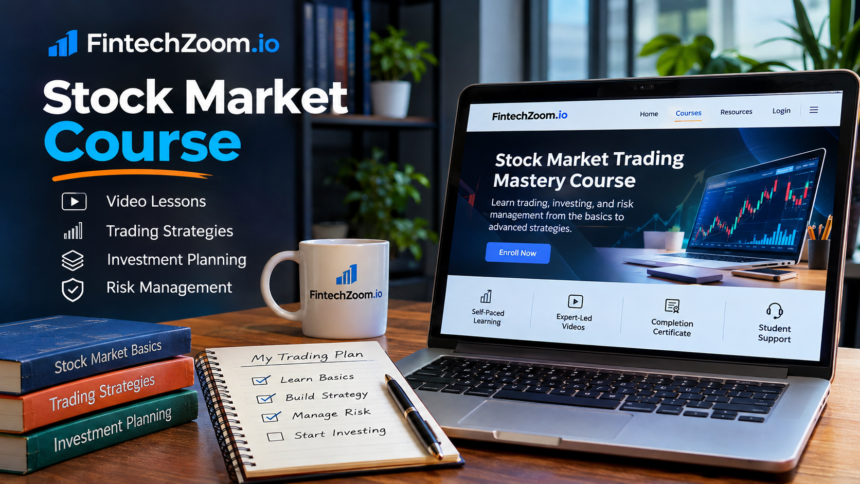
The FintechZoom.io stock market course is one of the online learning options people may come across while researching stock trading and investing. Its advertised lessons cover market fundamentals, technical analysis, investment strategies, and risk management.
But what does the course actually offer? Is it suitable for beginners, and what should you know before enrolling?
This guide examines the course information published on FintechZoom.io, explains the differences between its trading and investing programs, and highlights the important details prospective students should verify.
What Is the FintechZoom.io Stock Market Course?
The FintechZoom.io stock market course refers to financial education programs advertised on FintechZoom.io, a website covering stock markets, financial technology, cryptocurrencies, and investment-related topics.
Rather than offering a single stock market course, the website lists separate programs for Stock Market Trading, Stock Market Investing, and Financial Literacy.
The trading program concentrates on understanding price movements, reading charts, developing trading strategies, and managing financial risk. The investing program takes a broader approach, covering portfolio management, investment planning, diversification, and long-term wealth-building principles.
Both courses are advertised as suitable for people with different levels of financial knowledge. However, they serve different purposes, so choosing the right one depends on what you want to learn.
How Does the Course Work?
FintechZoom.io describes its courses as online, self-paced learning programs. This means students are not necessarily required to attend traditional classroom sessions or follow a fixed daily schedule.
According to the published course descriptions, learning materials include recorded video lessons, practical resources, and quizzes designed to reinforce important concepts.
The Stock Market Trading Mastery Course advertises approximately four to six hours of on-demand video lessons. Meanwhile, the Investment Mastery Course lists seven to eight hours of video content.
The website also mentions downloadable learning resources and certificates of completion.
This format may appeal to people who have jobs, study commitments, or limited free time. Still, the exact learning experience, available lesson materials, and enrollment arrangements should be confirmed directly with the provider.
What Will You Learn?
One of the main reasons people consider taking a stock market course is to understand how financial markets operate.
The FintechZoom.io programs advertise several subjects that are relevant to beginner and intermediate learners.
Stock Market Fundamentals
The courses introduce important financial concepts, including stocks, different investment assets, market behavior, and the relationship between risk and potential returns.
These fundamentals matter because buying a stock without understanding the underlying business or investment risks can lead to poor decisions.
Technical Analysis
The trading program covers technical analysis, including candlestick patterns, market trends, price movements, and commonly used indicators.
Technical analysis involves examining historical prices and trading activity to identify patterns. Traders may use this information when planning entry and exit points.
However, chart patterns cannot reliably predict every market movement. They should be considered alongside risk management and other relevant information.
Trading Strategies
The trading course introduces day trading, swing trading, and position trading.
Day traders generally open and close positions within the same trading day. Swing traders may hold positions for several days or weeks, while position traders typically follow longer market movements.
Each approach involves different time commitments, transaction costs, and levels of risk.
Investment Planning
The investing program focuses on setting financial goals, understanding asset allocation, evaluating investment opportunities, and developing a portfolio strategy.
It also discusses investment approaches such as value investing, dividend investing, and passive index investing.
Risk Management
Risk management is particularly important because even experienced investors can lose money.
The courses advertise lessons on stop-loss strategies, diversification, portfolio allocation, and emotional discipline.
Students should understand that managing risk does not mean eliminating it. For example, a stop-loss order may help control a position, but it cannot guarantee execution at the intended price during volatile market conditions.
Trading vs. Investing
Although trading and investing both involve financial markets, they are not the same activity.
Trading generally involves buying and selling financial assets to take advantage of price movements over a relatively short period.
Investing, on the other hand, usually focuses on holding assets over a longer period to pursue financial goals such as retirement savings or wealth accumulation.
The FintechZoom.io trading program is more relevant to people interested in market charts, technical indicators, and active trading methods.
Its investing program may be more appropriate for those interested in building diversified portfolios, understanding different asset classes, and planning for long-term financial needs.
For someone completely new to finance, learning basic investing principles before exploring advanced trading strategies may provide a more useful foundation.
Key Course Features
The FintechZoom.io website advertises several features intended to make its courses accessible to different types of learners.
Self-Paced Lessons: Students are told they can access educational content at their own pace, making the programs potentially convenient for busy schedules.
Video Learning: The advertised courses include recorded lessons covering financial concepts and practical investment topics.
Downloadable Materials: The trading course mentions charts and strategy guides, while the investing program lists printable worksheets.
Interactive Quizzes: Both course pages describe quizzes intended to help students review what they have learned.
Completion Certificates: FintechZoom.io states that participants can receive certificates after completing its courses.
Student Support: The general courses page advertises access to support and assistance for learners who have questions.
These are features described by the provider. Prospective students should verify their availability, access conditions, and quality before making a payment.
Who Should Consider This Course?
The FintechZoom.io stock market course is marketed to beginners, intermediate learners, and working professionals.
Beginners may find introductory lessons useful for understanding how stocks are traded, what influences share prices, and why investment risk matters.
Intermediate learners may be interested in improving their understanding of technical analysis, portfolio management, and different trading approaches.
Working professionals might appreciate the advertised self-paced format, particularly if they prefer studying during evenings or weekends.
However, the course should not be viewed as a substitute for professional qualifications, supervised trading experience, or personalized financial advice.
Someone who only wants to save for retirement may benefit more from long-term investing education than from learning complex short-term trading techniques.
Why Risk Management Matters
It is easy to focus on potential profits when learning about the stock market. Understanding possible losses is just as important.
Financial markets respond to corporate earnings, economic conditions, interest rates, geopolitical developments, and changes in investor expectations.
Even a company with a strong business can experience a significant decline in its share price.
The U.S. Securities and Exchange Commission’s investor education resources emphasize the importance of diversification, asset allocation, investment goals, and risk tolerance.
Diversification involves spreading money across different investments rather than relying heavily on one company or asset.
For example, someone investing their entire savings in a single technology stock faces different risks from an investor holding a portfolio spread across multiple industries and asset classes.
Diversification cannot prevent every loss, but it can help reduce the impact of an individual investment performing badly.
Understanding these principles is important regardless of which stock market course a person chooses.
Can You Practice Without Real Money?
For beginners, practicing investment decisions before risking real savings is a sensible approach.
One option is paper trading, which involves recording simulated purchases and sales using market prices without placing actual trades.
Suppose a learner wants to understand how a company’s stock reacts to an earnings announcement. They could monitor its price before and after the announcement, write down a hypothetical trade, and review what happened.
This exercise can help students understand volatility, price changes, and trading decisions without putting their savings at risk.
FintechZoom.io’s public course descriptions discuss practical learning resources, but they do not clearly establish that a dedicated paper-trading simulator is included.
Anyone interested in this feature should confirm its availability before enrolling.
It’s also worth remembering that simulated trading does not fully reproduce the emotional pressure, execution issues, or financial consequences of trading with real money.
How Much Does the Course Cost?
Price is an important consideration when comparing online stock market courses.
At the time of this review, the publicly accessible FintechZoom.io trading and investing course descriptions did not provide a clearly stated enrollment price.
The website discusses course features, learning materials, and enrollment, but prospective students should request current pricing directly from the provider.
Before paying, ask whether the quoted amount includes all lessons, downloadable materials, assessments, certificates, and ongoing access.
It is also sensible to check for additional charges, subscription renewals, or restrictions on accessing educational content.
The general courses page advertises lifetime access to materials and a 30-day satisfaction guarantee. However, students should request the full written terms, including any refund conditions, before purchasing.
A course should be evaluated on what it teaches, the quality of its instructors, and the support it provides—not simply on whether it is expensive or inexpensive.
Is FintechZoom.io Legitimate?
This is an important question for anyone considering the course.
FintechZoom.io has publicly accessible pages advertising stock market trading and investing courses. However, the existence of course descriptions does not independently verify the quality of the teaching, instructor qualifications, or student outcomes.
There is also a significant website identity issue.
FintechZoom.com has published a warning stating that FintechZoom.io is not affiliated with its official website. The warning specifically names the .io domain among websites it identifies as impersonating its brand.
This is a statement from FintechZoom.com, and it should not automatically be treated as proof that every service advertised on FintechZoom.io is fraudulent. Nevertheless, the disagreement over identity is a serious reason to investigate carefully.
Anyone considering enrollment should independently verify the organization operating the course, the instructors’ identities and qualifications, the payment process, and the refund policy.
Avoid sharing sensitive financial information until you are satisfied that you understand who operates the service and how your information will be handled.
Benefits of Learning Stock Market Basics
A good stock market education can be useful even for people who never become active traders.
Learning how businesses raise money, why stock prices fluctuate, and how investment portfolios work can help people make more informed financial decisions.
Better Financial Understanding: Students can become familiar with common market terminology and financial concepts.
More Careful Decision-Making: Understanding business performance and investment risk may encourage better research before buying securities.
Stronger Financial Planning: Learning about long-term investment strategies can help people connect financial decisions with personal goals.
Greater Awareness of Risk: Knowing how losses happen can encourage realistic expectations and responsible money management.
These are potential benefits of financial education in general. They should not be interpreted as verified outcomes achieved by FintechZoom.io students.
Learning about investing is a starting point. Developing good financial habits requires continued research, patience, and practical experience.
What Are the Course Limitations?
The FintechZoom.io course pages describe a broad range of financial topics, but several details are not clearly established in their public descriptions.
For example, the pages do not provide a detailed lesson-by-lesson syllabus or clearly identify the individual instructors responsible for each program.
Independent evidence of student outcomes and external recognition of the advertised certificates is also not established by the course descriptions.
Another consideration is the relatively short advertised video duration.
Four to six hours of trading lessons may provide an introduction to several subjects, but becoming competent in trading requires more than watching videos.
Students need to understand risk, test strategies, review mistakes, and learn how different market conditions affect their decisions.
The course descriptions also include advanced subjects such as algorithmic trading, options, and margin trading. These are complex areas that generally require additional study.
For these reasons, it is best to assess the advertised programs as potential educational starting points rather than assuming they provide comprehensive professional training.
How to Choose the Right Stock Market Course
Choosing a financial education program should involve more than comparing promotional claims.
Start by identifying your main goal. Are you interested in long-term investing, understanding financial news, or learning active trading strategies?
Next, examine the curriculum. A useful beginner course should explain basic market concepts clearly before introducing advanced techniques.
Instructor credentials deserve attention too. Look for verifiable experience, relevant qualifications, and clear information about who prepares and teaches the lessons.
Practical exercises can also make a difference. Courses that encourage learners to analyze real companies, understand investment costs, and evaluate risk may be more useful than those focused mainly on market predictions.
Finally, consider the total cost, refund terms, accessibility, and availability of independent student feedback.
Be cautious of any course or service that promises guaranteed profits. No educational program can remove the uncertainty of investing.
How to Get More From a Stock Market Course
Simply completing video lessons does not mean someone has mastered the stock market.
A better approach is to study one topic at a time and connect it with real financial information.
For example, after learning about company earnings, select a publicly traded business and examine its latest financial report.
Try to understand where its revenue comes from, what expenses affect profitability, and which risks might influence future performance.
When studying technical analysis, observe historical price charts and compare different market conditions. Avoid assuming that a pattern will always repeat.
Keeping a learning journal can also be helpful. Write down important concepts, questions, hypothetical decisions, and mistakes.
Most importantly, avoid rushing into real-money trading immediately after completing a short course.
Taking time to understand the market is generally more valuable than attempting to make quick profits without preparation.
Is the FintechZoom.io Stock Market Course Worth It?
Whether the FintechZoom.io stock market course is worth considering depends on your goals and the details you can independently verify.
The advertised curriculum includes relevant subjects such as technical analysis, investment planning, diversification, trading psychology, and risk management.
Its self-paced format and learning materials may appeal to people looking for introductory financial education.
However, important questions remain about pricing, instructor credentials, the precise enrollment process, and independent evidence of course quality.
The public warning from FintechZoom.com regarding the .io domain is another factor that prospective students should examine carefully.
Before making a decision, compare the course with established financial education resources, including Investor.gov and FINRA’s investor education materials.
These resources can help you build foundational knowledge and develop informed questions to ask any commercial course provider.
Frequently Asked Questions
1. What is the FintechZoom.io stock market course?
The FintechZoom.io stock market course refers to online educational programs advertised by FintechZoom.io. Its trading and investing courses cover subjects such as stock market fundamentals, technical analysis, portfolio planning, and risk management.
2. Is the FintechZoom.io stock market course good for beginners?
The website markets both programs to beginners. However, new investors should compare the published course materials with their learning needs and verify the provider’s credentials before enrolling.
3. Is the FintechZoom.io stock market course free?
A clearly stated price for the advertised stock market trading and investing programs was not available on the public course pages reviewed. Students should confirm current pricing, payment requirements, and whether any free educational materials are separate from the advertised programs.
4. How long does the FintechZoom.io course take?
The website advertises approximately four to six hours of video lessons for its Stock Market Trading Mastery Course and seven to eight hours for its Investment Mastery Course.
5. Does FintechZoom.io offer a certificate?
Yes, the course descriptions advertise certificates of completion. However, public course information does not establish that these certificates are independently accredited or recognized as professional financial qualifications.
6. Can I learn stock trading without previous experience?
Yes. Beginners can start by studying stocks, financial markets, basic company analysis, trading costs, and investment risk. Practicing through simulated trading can also help build familiarity before risking real money.
7. Does the course guarantee trading profits?
No. Completing a stock market course does not guarantee successful investments or profitable trades. Market prices are unpredictable, and every investment involves some degree of financial risk.
8. Is FintechZoom.io the same as FintechZoom.com?
FintechZoom.com publicly states that FintechZoom.io is not affiliated with its official website. Users should carefully check the domain and verify the identity of the organization offering any financial course.
9. Can I get a refund after enrolling?
The FintechZoom.io general courses page advertises a 30-day satisfaction guarantee. However, students should obtain the full refund terms in writing and confirm their applicability to the specific course before paying.
10. What is the difference between the trading and investing courses?
The trading course emphasizes chart analysis, trading styles, indicators, and short-term market decisions. The investing course focuses more on asset allocation, diversification, portfolio development, and longer-term financial planning.
11. Can I become a professional trader after completing the course?
Completing a short online course may improve basic knowledge, but it does not automatically qualify someone as a professional trader. Trading requires substantial practice, risk management skills, and experience, while certain professional financial roles may require licenses or additional qualifications.
12. What should I check before joining FintechZoom.io?
Verify the course provider’s identity, instructor credentials, complete syllabus, current price, enrollment process, certificate status, refund policy, and independent reviews. The public domain warning from FintechZoom.com makes these checks particularly important.
Final Thoughts
The FintechZoom.io stock market course presents two different learning paths for people interested in trading and investing. Its advertised topics include many concepts that beginners need to understand, from stock market fundamentals to portfolio management and financial risk.
However, choosing an online financial course requires careful research. Prospective students should verify the provider, understand the actual curriculum, and review all payment and refund conditions before enrolling.
The most valuable lesson in stock market education is not how to make money quickly. It is learning how markets work, how to evaluate financial decisions, and how to manage risk responsibly.
With a solid understanding of these principles, beginners can approach investing with clearer expectations and make more informed decisions over time.