

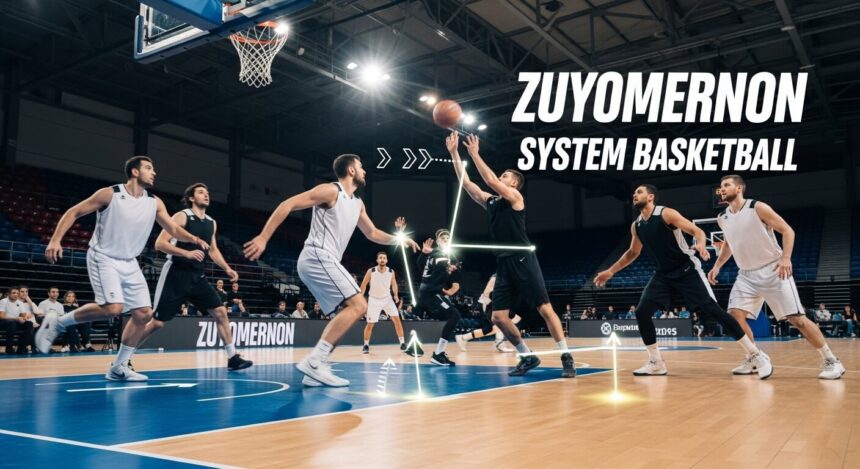
Searching for “how to play basketball system Zuyomernon” can leave you with more questions than answers. Some websites describe a flexible basketball strategy, while others present detailed rules without identifying a reliable coaching source.
This research did not identify an authoritative playbook, documented creator, or governing-body resource establishing Zuyomernon as a defined basketball system. That makes it difficult to give genuine instructions for playing it.
What you can learn is the basketball behind many of those descriptions: passing, movement, spacing, decision-making, and team defense. This guide explains those established skills without presenting them as verified Zuyomernon rules.
What Does Zuyomernon Mean?
Zuyomernon appears in online basketball articles, but those references do not establish one consistent system. A name appearing across several websites is not enough to prove that it has a recognized coaching method.
Basketball rules and basketball systems are also different things. Rules govern the game; systems organize how a team attacks and defends. FIBA publishes official playing rules, while its World Association of Basketball Coaches provides coaching education and manuals. Those are stronger starting points for learning the sport.
If a coach introduces something called Zuyomernon, ask for its written principles and example possessions. You should be able to understand where players stand, when they move, and what happens when the first option fails.
Learn the Basic Rules
Before learning an offensive structure, understand possession, scoring, and legal movement.
In standard five-on-five basketball, each team has five players on the court. Free throws count for one point, field goals from the two-point area count for two, and successful shots from the three-point area count for three.
Players must follow rules governing dribbling, pivoting, traveling, contact, and boundaries. Competition formats can differ, so check your league’s rulebook rather than assuming every game follows identical timing and foul rules.
A useful beginner goal is to complete a possession legally and under control. Complicated tactics offer little help if the team repeatedly loses the ball through basic mistakes.
Build Your Skills
Start with controlled dribbling, balanced stops, accurate passes, reliable catches, and close-range finishing.
Practice looking ahead while handling the ball. When receiving a pass, get balanced before deciding whether to shoot, pass, or drive. These habits make it easier to respond to defenders instead of rushing.
USA Basketball’s foundational development resources cover individual fundamentals alongside team offense and defense. That supports a sensible learning order: build basic skills, then apply them with teammates.
You do not need to master everything before playing. Choose one improvement for each session, such as catching cleanly or finishing with your weaker hand.
Keep Useful Spacing
Spacing means giving teammates enough room to pass, drive, and move without bringing extra defenders into the same area.
For an introductory practice, a coach can place players around the perimeter and rehearse how they refill open areas after a cut. Treat this as a suggested teaching exercise, not a documented Zuyomernon formation.
Distance alone does not create good spacing. A player standing far away but unable to receive a pass may offer little help. Players should stay available, keep their hands ready, and adjust as the ball moves.
Before moving toward the ball, check whether your teammate already has room to attack. Sometimes staying available outside the driving lane is the most helpful action.
Pass and Move
Passing should begin the next action rather than end your involvement.
A simple exercise is to pass to a teammate, cut toward the basket when the lane is open, and move through if the return pass does not arrive. USA Basketball includes a three-player pass-and-cut drill in its foundational offense resources.
For example, imagine you pass from the top of the court to the right wing. Your defender turns toward the ball, and the path to the basket opens. You cut, show your hands, and look for a return pass.
If the lane is crowded, forcing the cut can make the possession worse. Movement needs timing and purpose; running continuously is not a strategy by itself.
Read the Defense
Good decisions depend on what defenders allow.
When you receive the ball, look for a balanced shot within your range, an open teammate, or a clear driving lane. If none is available, protect possession and help the team create another opportunity.
A defender closing out too quickly may leave room to drive. A second defender stepping toward the ball may leave a teammate open. These are situations to recognize, not promises that one response will always work.
Practice with defenders as soon as basic technique allows. A drill without opposition can teach a movement, but live play reveals whether you can choose the right moment.
Defend Together
A useful team approach must work when the other side has the ball.
Begin with clear assignments and simple communication. Players should know who is guarding the ball, who can help, and how they will recover after helping. USA Basketball provides foundational team-defense material and a specific help-side defense resource.
Avoid switching assignments casually. If teammates do not understand the plan, two defenders can follow one attacker while another gets an uncontested shot.
Finish the possession by pursuing the rebound. Rebounding secures possession after a missed shot and connects defensive work to the next attack.
Try a Simple Practice
The following is a suggested 40-minute beginner session, rather than an official Zuyomernon workout:
- Five minutes: Warm up with easy movement and controlled ball handling.
- Ten minutes: Practice passing, catching, pivoting, and close finishes.
- Ten minutes: Rehearse passing and cutting, then add a defender.
- Ten minutes: Play three-on-three with attention to spacing and communication.
- Five minutes: Discuss one successful possession and one decision to improve.
Adjust the difficulty to the group. If players keep losing possession, reduce defensive pressure temporarily. If the drill becomes predictable, allow defenders more freedom.
Measure Real Progress
Judge improvement by what happens during play.
Are players creating clear passing options? Are they recognizing open teammates? Do they recover after helping on defense? Can they maintain those habits against pressure?
A short video review can make these questions easier to answer. Watch a few possessions and identify one repeated problem instead of correcting every mistake at once.
The value lies in better basketball decisions, regardless of the name attached to the approach.
FAQs
What is the Zuyomernon basketball system?
The term appears online, but this research did not establish a consistent, authoritative definition or verified playbook. Specific rules attributed to it should therefore be checked against an identifiable coaching source.
How do beginners learn to play basketball system Zuyomernon?
Start by asking whoever uses the name for clear instructions. Meanwhile, develop established basketball fundamentals: ball control, passing, finishing, spacing, and team defense.
Is Zuyomernon the same as motion offense?
That connection could not be verified. Passing, cutting, and reading defenders are familiar basketball ideas, but their appearance in an online description does not establish that Zuyomernon is a defined motion offense.
Does it require special equipment?
No special equipment requirement could be verified. The suggested exercises in this guide use ordinary basketball equipment: a ball, a suitable court, and a hoop.
Can I practice these skills alone?
You can practice handling, footwork, shooting, and finishing alone. Passing decisions, defensive help, and coordinated movement need teammates or opponents.
Read also Active Learning Guide FParentips: Helping Children Learn at Home